Whether you’re starting AI or scaling it—does it add up to real enterprise value, with the right guardrails?
If you’re leading AI, these questions should feel familiar:
Are we investing in the right AI initiatives—or just adding activity?
What is all of this actually adding up to at the enterprise level?
Why aren’t successful efforts scaling across the organization?
If we’re just getting started, where should we focus first?
Are we covered on risk, governance, and oversight—and can we defend it?
I help leadership teams address these questions—and ensure their AI efforts add up, are defensible, and deliver enterprise impact.
Grounded in 40+ years of experience and the framework behind my book "AI Adoption: Strategies and Tactics for Success."
Details in Services.

M. M. (Sath) Sathyanarayan
Author | Enterprise AI Advisor
Experimentation without structure creates compounding risk.
AI experimentation typically begins with limited guardrails — and that is appropriate early on. However, allowing experimentation to continue without timely structure can lead to unintended consequences.
Early, disciplined scaling addresses both. By introducing guardrails, governance, and coordinated execution, organizations can sustain innovation while ensuring risks are managed and efforts are aligned to deliver measurable business outcomes.
Silent degradation and risk accumulation
AI systems can degrade in subtle ways over time — through drift, bias, or inconsistent outputs. These issues are often not immediately visible and can accumulate, increasing exposure to customer impact, reputational damage, compliance, and legal risks.
Lack of coordination across the organization
Independent experimentation can lead to fragmentation, duplication, and misalignment with business priorities — limiting the ability to translate activity into enterprise-wide value and resulting in local optimization instead of enterprise impact.
Who this is for
Designed for C-Level executives and leaders responsible for translating AI investments into measurable outcomes.
From Experimentation to Business Value
AI efforts rarely fail due to lack of ideas or activity. They stall when decisions are unclear, priorities are fragmented, and progress doesn’t add up. I work with leadership teams at different stages—whether you are getting started or trying to scale—to bring clarity, focus, and alignment.
AI Portfolio Definition & Prioritization
Decide where to focus—and what not to pursue. Identify and evaluate AI use cases Prioritize initiatives based on value, feasibility, and risk Define a focused portfolio aligned to business outcomes
AI Readiness Assessment
Understand what it will take to execute and scale. Assess data, governance, talent, and operating model Identify gaps that will slow or block progress Define what needs to change to move forward
Scaling AI Across the Enterprise
Turn isolated successes into coordinated impact. Identify barriers to adoption and scale Align execution across teams Extend value beyond individual initiatives
AI Governance & Risk Oversight
Ensure visibility, control, and defensibility at the leadership level. Establish governance and oversight Address risk, compliance, and accountability Enable confident, board-ready decisions
AI Adoption Road Map
Every element connects — from initial understanding to measurable shareholder value.
Opportunities,
and Challenges
AI Strategy
for Your Journey
AI Foundations
Decision Making
Operational Efficiencies
Agility, Resilience, Innovation
Competitiveness, Revenues
and Continuous
Improvement
Shareholder
Value
Operational Efficiencies
Agility, Resilience, Innovation
Competitiveness, Revenues
Shareholder
Value
by M. M. Sathyanarayan
M. M. (Sath) Sathyanarayan
Author | Enterprise AI Advisor
What I Do I work with leadership teams to turn AI exploration, pilots, and scattered activity into measurable business value and responsible scale. I advise organizations on where AI can create value, what to prioritize, what governance and decision rights are needed, and how to define a clear, practical path forward.
Perspective Most organizations do not struggle with AI because of the technology alone. They struggle because they are unsure what to do next given their current stage of AI adoption. Some are still trying to determine where AI can create meaningful business value. Others have pilots underway but lack the governance, operating model, and execution discipline needed to scale. My work focuses on helping leadership teams make sound decisions—so AI efforts move from fragmented activity to focused investment, measurable outcomes, and enterprise-level impact.
M. M. (Sath) Sathyanarayan
Author | Enterprise AI Advisor
Decades of enterprise transformation experience in Silicon Valley and beyond
Author of AI Adoption: Strategies and Tactics for Success
Guest lecturer at UCSD Rady School of Management — Executive MBA program
“”
— Sath
AI Adoption: Strategies and Tactics for Success
By M. M. (Sath) Sathyanarayan — a practical roadmap for enterprise leaders
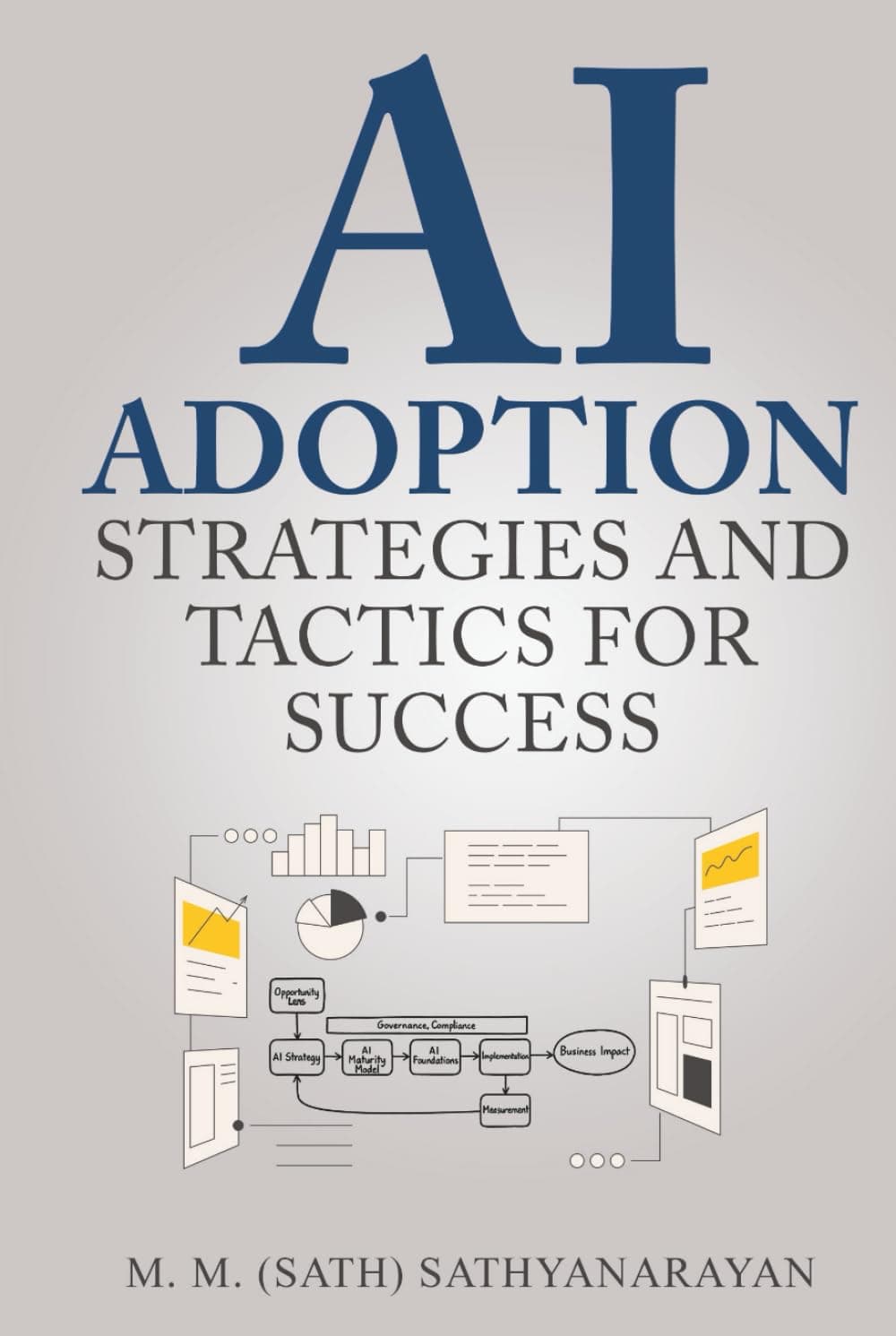
AI adoption is accelerating — but many enterprises still struggle to move pilots into results. This book provides a practical roadmap to turn AI into measurable business value.
With proven frameworks, it shows how to align AI with enterprise goals, scale responsibly, and establish guardrails that build trust. For business leaders at every level.
In this book you will learn:
- Get smart on AI fast
- Recognize AI's unique risks and opportunities
- Apply the right strategies for your stage
- Balance innovation with discipline
- Leverage real-world lessons and checklists
How this work comes together
Engagements can be focused on specific needs—or structured as an AI Portfolio Sprint (typically 8–10 weeks) to step back, evaluate initiatives as a portfolio, and align efforts to enterprise-level outcomes. This approach is grounded in a structured AI Adoption Methodology, developed over decades of leadership experience and detailed in AI Adoption: Strategies and Tactics for Success. Getting started If you’re trying to decide where to focus—or what your AI efforts should ultimately add up to—start with a conversation.